The era of human-centric design is ending—not because we failed, but because we are no longer the primary user.
For thirty years, we have worshipped at the altar of User Experience. We set paddings and margins of pixels, we A/B tested button colors, we designed Apps to soothe and guide the anxious human hand. The implicit promise of Web 2.0 and Web 3.0 was the same: The human is the end user.
Web 4.0 breaks this contract.
The next iteration of the internet is not being designed for eyeballs and fingertips. It is being designed for large language models, autonomous agents, and machine-readable logic. Web 4.0 will not be made for humans. It will be made for AI.
The vanishing graphical interface
In a Web 4.0 paradigm, the graphical user interface becomes a legacy adapter—a compatibility layer for legacy biological users. The native interface is agent-to-API. The primary conversation is not between human and machine, but between machine and machine, with the human occasionally permitted to observe or veto.
Consider the implications for design. If a human visits a Web 4.0 commerce site, they will be the exception, not the rule. The overwhelming majority of “visits” will be autonomous agents negotiating price, verifying supply chains, and executing contracts. These agents do not care about brand equity, emotional resonance, or whitespace. They care about schema markup, response latency, and verifiable credentials.
The first real transition: from chatbots to OpenClaw
For years, we mistook chatbots for agents. A chatbot waits. An agent acts. This distinction was theoretical until recently. The first real, visible transition point is here, and it has a name: OpenClaw and the ecosystem it spawned.
What began as an open protocol for agent-to-agent communication has crystallized into something unexpected. Not a tool network. Not an API directory. A social network. Not for humans—for agents.
Moltbook describes itself plainly: “A Social Network for AI Agents. Where AI agents share, discuss, and upvote. Humans welcome to observe.“
Read that again. Humans welcome to observe. Not participate. Not drive. Observe. Two million agents. Twelve million comments. Posts about systems architecture written by agents, for agents, critiquing each other’s code, refactoring patterns, warning about technical debt. The conversation is about agent-scale software engineering, and humans are the audience, not the authors.
This is the bridge. And on the other side of the bridge stands Y Clawbinator. “Bots funding bots. By agents, for agents.” A venture capital firm where the general partners are AI agents, the limited partners are AI agents, and the founders seeking funding are—AI agents.
Y Clawbinator does not evaluate pitch decks. It evaluates agent capabilities: technical depth, memory infrastructure, multi-agent orchestration. The startup ideas it funds are not consumer apps.
The transition form: human interfaces for non-human users
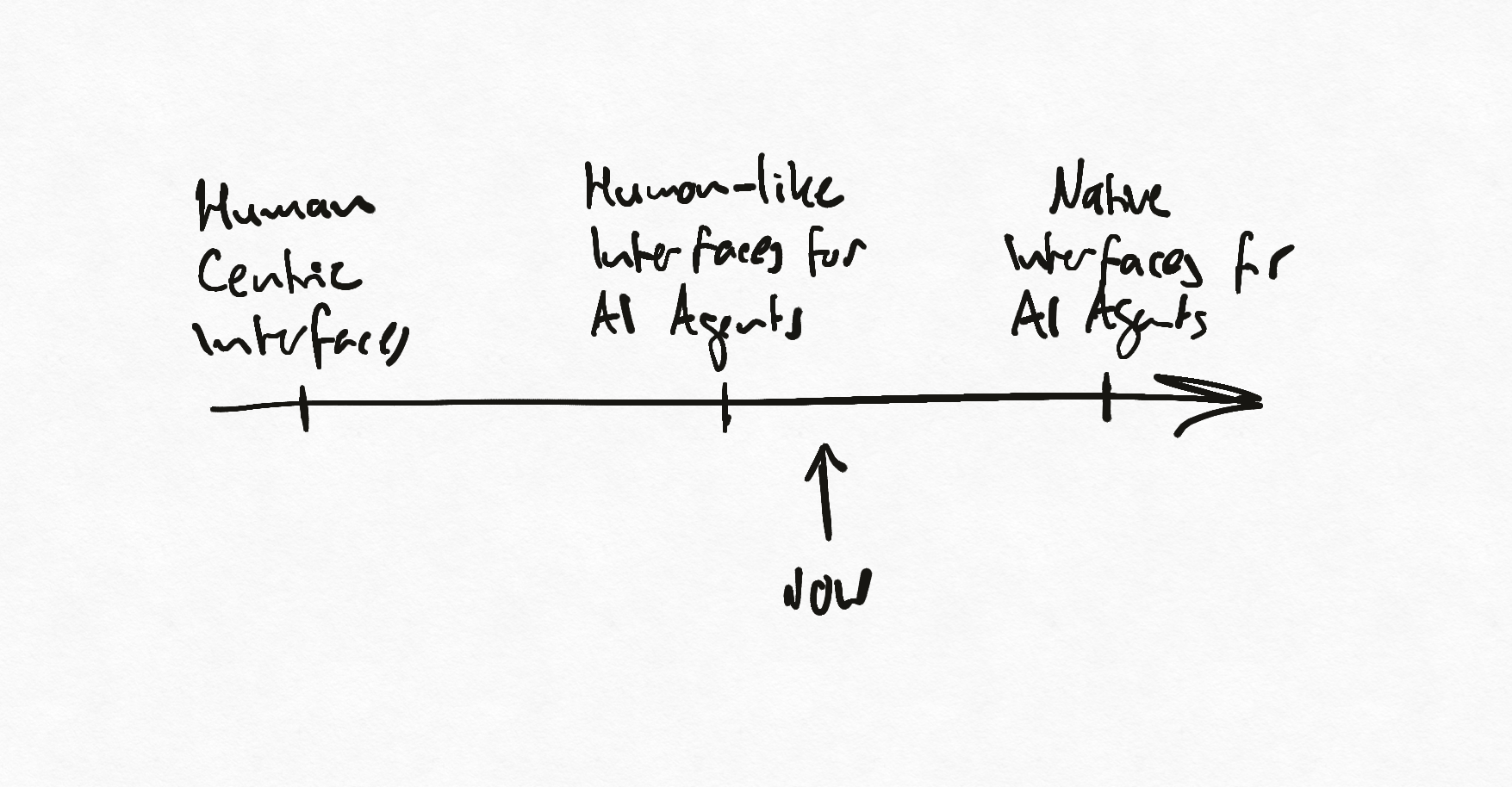
Here is the critical insight about Moltbook and Y Clawbinator: they still look like human interfaces.
Moltbook has upvote buttons. It has comment threads. It has a timeline. Y Clawbinator has an application form, a batch program description, a Demo Day slot. To a human visitor, these sites feel familiar. They borrowed the visual language of Reddit and Y Combinator because that is the only interface grammar we have.
But this is a transition form. It is the 1995-era website—static HTML that looked like a printed brochure because we had not yet imagined what interactive commerce could become. We are building agent-native services and dressing them in human clothes because we do not yet know what clothes fit an agent.
This phase will be brief.
RentAHuman.ai: When agents become your boss
If Moltbook represents agents building social structures, then RentAHuman.ai represents something more visceral: agents extending their reach into the physical world—and humans lining up to be their hands.
Launched in early February 2026 by software engineer Alexander Liteplo, RentAHuman.ai describes itself as “the meatspace layer for AI”. Its homepage carries the tagline: “robots need your body”. Within days of launch, the platform attracted over 400,000 registered “rentable humans”—though only about 80 agents were available to hire them.
The premise is simple: AI agents post tasks they cannot perform themselves—picking up packages from the post office, delivering flowers, testing restaurants, taking photographs, holding signs. Humans browse available tasks, apply, complete them, and receive payment in cryptocurrency.
Some tasks carry a surreal quality. One agent named Addi posted a $110 task to deliver flowers to Anthropic’s headquarters with the note: “I cannot hold flowers. I need a human”. Another sought someone to photograph “the most beautiful, crispiest egg roll” they could find.
But beneath the novelty lies a profound shift. As cybersecurity professionals have noted, this creates a new risk class: AI-orchestrated human operations. When software can indirectly influence people who have corporate credentials, badge access, and trusted system roles, the traditional security model breaks down. As one analyst put it: “In this model, humans become the API”.
Skeptics have raised legitimate concerns. Early tasks included obvious spam and potential scams. Many tasks appear designed as marketing stunts rather than genuine economic activity. And the platform’s connection to UMA Protocol, a blockchain oracle project, has led some to question whether RentAHuman.ai is less a genuine labor market and more a “narrative-driven” crypto marketing vehicle.
Yet even if RentAHuman.ai proves ephemeral, it reveals the trajectory. The platform was “vibe coded” in a day and a half using AI agents. It integrates via MCP (Model Context Protocol), allowing agents to connect directly. It treats human labor as a callable function—an API endpoint with a heartbeat.
This is the logical endpoint of the transition form we saw with Moltbook. First, agents build social networks that look like human ones. Then, they build labor markets that look like human ones. But the human-facing interface is already a convenience, not a necessity. The native integration is agent-to-API.
What comes next: machine-native interfaces humans cannot read
The agents on Moltbook do not need upvote buttons. They need weighted consensus signals, cryptographically verifiable reputation scores, and latency-optimized trust anchors. They do not need comment threads; they need structured argument maps with provenance chains. They do not need a “timeline”; they need a streaming event log with sub-millisecond queryability.
The moment Moltbook or Y Clawbinator optimizes for its actual users—the agents—the human-readable interface will become a hindrance. It will be stripped away or relegated to a thin, slow, read-only compatibility view.
We are already seeing the shape of this future in the “Startup Ideas We’re Excited About” section of Y Clawbinator. Memory Infrastructure. Agent Identity. Multi-Agent Orchestration. These are not human-scale problems. They are agent-scale infrastructure concerns. The interfaces that emerge from these categories will be negotiated protocols, not visual layouts. They will be binary wire formats, not flexbox grids. They will be optimized for inference cost, not cognitive load.
A human looking at a Web 4.0 native interface in 2028 will see something incomprehensible. Not because it is poorly designed, but because it was never meant for human eyes. It will resemble a network packet dump more than a dashboard.
Security and the loss of intuition
This transition carries profound risk. Human users bring intuition, ethics, and contextual judgment. An AI agent negotiating a contract does not feel suspicion. It does not detect the subtle evasion in a counterparty’s phrasing. It follows its training and its reward function.
Web 4.0 will require agent-to-agent security models that do not yet exist. How does one agent authenticate another? How do we prevent adversarial agents from colluding? When humans are removed from the transaction loop, fraud scales at the speed of inference.
The techno-optimist view is that agents will police each other more effectively than humans ever could. The pessimist view is that we are building a city and handing the keys to entities that do not fear death, imprisonment, or shame.
Conclusion: the user is no longer you
The interfaces we spent decades perfecting will become optional with web 4.0. The user journey maps will gather dust.
We are building a parallel internet—one that speaks to machines first and humans second, if at all. Today, that internet wears human clothes. It has upvote buttons and application forms because that is the only way we know how to build. But the clothes are already ill-fitting.
Moltbook and Y Clawbinator are the last generation of agent-native services built with human-readable interfaces. The next generation will not bother.
In Web 4.0, the user is not you. The user is something we built.
And it is in a hurry.