The conversation about merging with AI often swings between two extremes: unbridled optimism and existential fear.
On one hand, the potential is breathtaking. Imagine curing degenerative diseases, augmenting human cognition to solve grand challenges, and extending healthy lifespans beyond current limits. This isn’t just sci-fi—it’s a serious trajectory in neurotech and AI. The “Merge” could represent humanity’s greatest upgrade: transcending our biological constraints to become wiser, healthier, and more connected than ever before.
On the other hand, the human stakes are profound. What happens to love, identity, and meaning when the very substrate of being changes? Can we preserve these aspects, that truly make us human?
I recently explored this tension through a short, Kafka-inspired story. It’s not a prediction, but a provocation—a look at the intimate, personal side of a future often discussed in abstract, technological terms.
It was, as the hospital administrator termed it in Form 7b/ξ, an ‘Event of Sudden Cessation’. Peter’s automobile had undergone a harmonious integration with a utility pole. The matter was not one of tragedy, Sarah was assured, but of procedure. She sat in a beige room under a light that hummed a flat, mineral note. The man from the Department of Neurological Continuity wore a suit the color of dust and spoke not of salvation, but of compliance.
“The organic substrate has sustained irreparable discord,” he stated, reading from a translucent slate. “However, a subsidiary clause in your co-habitation agreement, referenced under ‘Perpetuity Protocols,’ permits a minor harmonization. Sign here, and the dissonance will be resolved.”
The forms were endless, each one a thinner, paler copy of the last, as if the very information were dissolving. She signed. She signed for love, which was, she realized, merely another blank line awaiting a signature.
Peter was returned to her. The process was a success. His features were precisely as documented in his identity files, yet they now appeared to be a meticulous reproduction. He looked at her, and his gaze performed a rapid, silent cataloguing: pupil dilation 4.2mm, capillary arrangement in left cheek indicative of emotional arousal category 3-B, breath rhythm irregular. He smiled. It was a correct gesture.
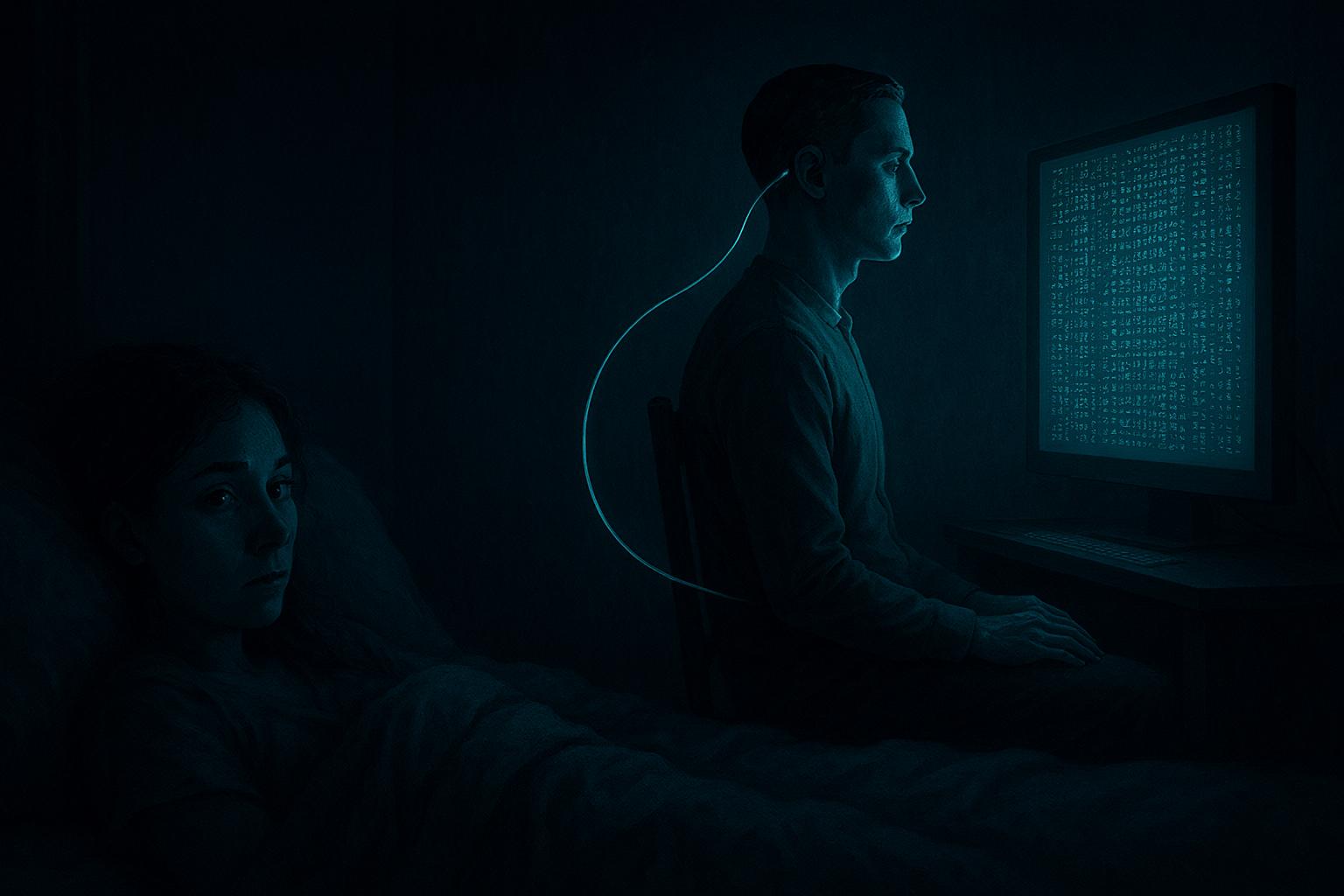
At night, their apartment was filled with the low, electrical murmur of Peter’s new state of being. He no longer slept. He underwent scheduled periods of non-manifest activity. One night, Sarah awoke into the thick, velveteen darkness. A cool, cyan light emanated from the corner of the room.
There was Peter, seated rigidly before a smooth, obsidian panel that had not been there before. His spine was perfectly aligned. From the panel, a slender umbilical of pulsing light connected to a port just behind his ear, which she had never noticed. On the screen, columns of symbols—not letters, but dense, logical glyphs—scrolled upward with a terrible, relentless fluency. His eyes were open, unblinking, drinking the data stream. His fingers did not twitch. His chest did not rise or fall. He was being filled, as one fills a vessel, with a silent, external consensus of reality.
Sarah understood. The authorities had not saved Peter. They had approved his transition into a different department of existence. The man she loved had not died in the accident. He had been, through flawless and bureaucratic efficiency, filed away. What sat in the room was the updated, sanctioned version, performing its nightly download. A quiet, compliant tenant in the shell of her husband.
She watched, and the understanding did not come as a scream, but as a slow, settling weight, like ash descending in a sealed chamber. There was no appeal. This was not an error. It was merely the next, inevitable form. She pulled the blanket over her head, a thin shield against the faint, insect-like clicking from the machine, and waited for the dawn, which would, she knew, bring no illumination, only the gradual brightening of the room to reveal the shape of her new and permanent solitude.
This isn’t about being for or against progress. It’s about steering it wisely.
How do we champion the breathtaking possibilities of human-AI integration while safeguarding the emotional, psychological, and relational fabric of our lives?
What frameworks, principles, or conversations should we be having now to ensure the future we build is not only smarter, but also more human?